leipzig2016:rhizome_project
Differences
This shows you the differences between two versions of the page.
| Both sides previous revisionPrevious revisionNext revision | Previous revision | ||
| leipzig2016:rhizome_project [2016/09/12 17:09] – markus | leipzig2016:rhizome_project [2016/10/25 17:02] (current) – markus | ||
|---|---|---|---|
| Line 1: | Line 1: | ||
| + | ====== Rhizome project ====== | ||
| + | {{: | ||
| + | |||
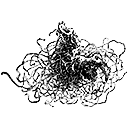
| + | The //rhizome// is a concept of thought, knowledge, presentation, | ||
| + | |||
| + | We held this session back in our Leipzig headquarter in Mariannenstraße on Saturday afternoon where Tobias Fritz joined us and started with a presentation by Markus. First a quote from Kafka, from his diaries 1910-1923: | ||
| + | > "Alle Dinge nämlich, die mir einfallen, fallen mir nicht von der Wurzel aus ein, sondern erst irgendwo gegen ihre Mitte." | ||
| + | |||
| + | Some motivations to operate with rhizomatic structures: | ||
| + | |||
| + | * In my PhD I had the problem of authorship. Of course some parts are clear citations but most of the work was greatly inspired by some books, papers, StackExchange threads etc. while no clear authorship can be given. Nothing in it is completely original thought, because all mathematical concepts already existed and where just maybe connected in a new way. So knowledge was created by combining / connecting old pieces. One could say more radically, that there is in fact no original thought, no essence in knowledge, everything is a combination of symbols, thoughts, and sensations that are in themselves such combinations. Yet our culture is obsessed with authorship and copyright! | ||
| + | * The concept of the //tree// is onmipresent in the occident and it always has an inherent hierarchy and thus represents power structures. One prominent example is the evolutionary tree (genealogical tree) but it has been shown that also [[wp> | ||
| + | * The most obvious example for a rhizomatic structure is of course the brain as a web of neurons, where the complexity of connections is responsible for the mental capability. And the structure of the brain will always connect in some ways to the structure of thought. | ||
| + | * In botany it is like the interconnected roots of grass (grassroot!) or clover (although those might not be rhizomes in a strict botanical sense), with no main root, different thickness, cyclic connections, | ||
| + | |||
| + | Principles of rhizomatic structures: | ||
| + | |||
| + | * interconnectivity and transformability | ||
| + | * heregogenity (every part looks differently) | ||
| + | * quality from the structure and quantity of connections, | ||
| + | * includes lines of connection //and// lines of " | ||
| + | * only parts of it are already functional, no core or heart needed (" | ||
| + | |||
| + | Applications in science: | ||
| + | |||
| + | * the body of science seen as a rhizome | ||
| + | * a theory can be used without a " | ||
| + | * mapping (" | ||
| + | * nomadic thinking and working (cf. [[wp> | ||
| + | * allow all kinds of connections and change of dominant structures or even the very base (different ontologies, paradigm shifts) | ||
| + | * follow escape routes, deterretorialize your thought, think unconventionally and outside of the box | ||
| + | * the rhizome always has different layers of representation, | ||
| + | * no clear authorship but a web of individual contributions and references, this calls for unrestricted access to the rhizome (copyleft) | ||
| + | * progress means growth in //all// directions, not linearily towards a hypothetical great goal of ultimate truth | ||
| + | * use adapted methods and formats: hypertext, wiki, [[https:// | ||
| + | |||
| + | This could also be a scheme for the organization inside the BRCP. There is no organizational centre of people that are responsible for activities but knots of activity arise more or less spontaneously (like now in Leipzig) from the interconnected web of members, i.e. temporal and local accumulations of creative activity that then dissolves and later and elsewhere forms new clusters while retaining some of the old connections. | ||
| + | |||
| + | Discussion: | ||
| + | |||
| + | Leo mentiones a game proposed by him, Johannes, and Ryszard where you name two arbitrary topics or objects (e.g. from maths) as vertices and then you try to come up with a connection, like: Lipschitz-continuity and donkeys. Well... | ||
| + | |||
| + | Tobias asks what the new model would be good for; Markus: be more productive, or productive in another way, more joyful, include more and different people, think more freely and creative | ||
| + | |||
| + | Our plan for a collaborative online tool representing this concept would be something like Wiki + Git + LaTeX + StackExchange (maybe Gitit is a practical solution) | ||
| + | |||
| + | A gedankenspiel about rhizomatic teaching (Florian)\\ | ||
| + | Suppose one would enter a seminar, a workshop or even just start at university and there would be only offers of different courses without any starting point like a very rhizomatic structure. What would be the challenge for the teacher and the class? | ||
| + | * He or she needs to speak for more or less any level of pre-knowledge (what actually also is true on a " | ||
| + | * the traditional tree structure allows for an easy way of integrating things into a big picture, because one at least has the impression that there is such a " | ||
| + | * a big practical problem could be that people "want their trees" because there are used to them, which is a normal process in human behaviour in my opinion. So also in this terms I think softness is important. We need to explain with good and easy examples why we should go another way. Also from the point of view that the tree needs not to be the neutral way of approach ALTHOUGH the people think that (have been taught that). | ||